• Over the last 15 years, SEO shaped how businesses produced content, structured websites, and competed for consumer attention. But the landscape is shifting fast. Traditional search engines are no longer the sole entry point into the digital world. Generative engines like ChatGPT, Gemini, Claude, Perplexity, and others, are becoming consumers’ first point of contact for information, decision-making, product recommendations, and brand discovery.

    This shift has triggered a fundamental change: LLMs don’t prioritize the same signals that search engines do. The technical architecture of a website now matters as much as (and often more than) traditional blog content. For companies, this is not just a trend, it’s a strategic earthquake.

    This article walks you through what changed, why it matters, and how organizations can adapt. If your brand needs to track its presence across multiple LLMs, this is exactly the landscape you need to understand.

    Why LLMs don’t “Read the Web” the same way Google does

    Traditional search engines work through crawling, indexing, ranking, and serving results from a database of URLs. Their core signals include backlinks, keyword relevance, content freshness, metadata, and domain authority. LLMs do something entirely different.

    LLMs learn from snapshots, structured data, and curated pipelines

    While each model has proprietary methods, the pattern is consistent:

    • They consume highly structured sources (Wikipedia, Common Crawl, academic corpora, open datasets).
    • They rely on technical files such as robots.txt, sitemap.xml, and emerging conventions like llms.txt.
    • They ingest large portions of the web in compressed form, not page-by-page like Google.
    • They don’t “rank” content, they synthesize it.
    • They use retrieval-augmented learning when connected to the live web, meaning structured data matters more than long-form copy.

    In practice, this means: Your blog posts still matter, but your site’s technical clarity matters more.

    Here are the most critical technical aspects you need to ensure your website adheres to, to ensure LLMs can process it:

    1. llms.txt

    Emerging standards like llms.txt are designed to tell generative engines:

    • what parts of the site may be used for training
    • what metadata is available
    • which files contain authoritative information
    • how product and service descriptions should be interpreted

    It’s early, but adoption is accelerating.

    2. sitemap.xml

    Search crawlers use sitemaps, but LLM pipelines rely on them even more, as they provide:

    • canonical URLs
    • relationships between pages
    • data freshness indicators
    • priority of content
    • structured definitions of product categories and brand entities

    A clean, accurate sitemap shapes how your brand is understood in model training pipelines.

    3. robots.txt

    This is an additional file you need to host alongside your sitemap, which determins:

    • what can be ingested by AI models
    • how scrapers interact with your site
    • which datasets include your content in future training cycles

    Some companies unknowingly block their entire presence from LLMs.

    4. Structured Data (schema.org)

    Models interpret structured markup (products, reviews, pricing, company info, FAQs) as high-confidence facts.

    A page with rich JSON-LD often influences an LLM more than a 2,000-word article.

    5. Repetition Across Trusted Sources

    Unlike Google, LLMs don’t operate on a single live index. Instead, they depend on seeing the same information repeated across several independent sources. If your brand appears:

    • in your own site
    • in partner sites
    • in product directories
    • in trusted public datasets
    • in reviews
    • in standardized schemas

    …it becomes far more likely the model will surface your company in its answers.


    The Bottom Line

    We’re living through the biggest shift in digital discovery since the rise of search engines. LLMs are becoming the new default interface for information, and if businesses don’t adapt, they’ll simply vanish from AI-generated answers.

    The companies that understand and invest in LLM visibility tracking now will dominate the next decade of digital presence.
  • The digital marketing landscape is undergoing its most profound transformation since the rise of mobile search. For years, Search Engine Optimization (SEO) has been the bedrock of digital strategy, focused on securing a spot on the first page of Google. But the rise of Large Language Models (LLMs) and generative AI, from ChatGPT and Gemini to Perplexity and AI-powered search results, has introduced a new, critical discipline: Generative Engine Optimization (GEO).

    This guide is a practical playbook for marketing professionals ready to master this new paradigm. We will define GEO, draw clear comparisons with traditional SEO, explain why tracking your brand’s presence in these new “Generative Engines” is crucial, and provide an actionable framework for optimization and measurement.

    The Paradigm Shift: Why SEO is No Longer Enough

    Traditional SEO is a game of links and clicks. A user asks a question, and the search engine responds with a list of ten blue links. Your success is measured by your ranking position and the resulting click-through rate (CTR). This has been the case for the past 20 years or so.

    However, when a user asks an LLM like ChatGPT a question, the model synthesizes a single, comprehensive, and conversational answer. This answer often cites sources or, more critically, incorporates information about brands, products, and services directly into the narrative.

    The goal has shifted from being the best link to being the definitive answer 1. If your brand is not the one being cited, recommended, or mentioned in that synthesized response, you are effectively invisible to a growing segment of the audience. GEO is the strategy to ensure your content is the source the AI chooses to generate its response 2.

    SEO vs. GEO: A Fundamental Comparison

    While GEO builds upon the foundational principles of SEO, such as authority and relevance, it introduces new priorities that demand a strategic pivot. The table below outlines the core differences between the two disciplines:

    FeatureSEOGEO
    Primary GoalAchieve high rankings (links) and drive organic traffic (clicks)Be the authoritative source cited or mentioned within the AI-generated answer
    Success MetricKeyword ranking, organic traffic, click-through rate (CTR), conversion rate.Mention Rate, Positioning Score, Attribution Quality (sentiment), AI Referral Traffic
    Content FocusText-heavy pages, keyword density, strong backlink profile.Multimodal content (text, video, images), conversational tone, clear structure
    Query TypeShort-tail and medium-tail keywords (e.g., “best running shoes”).Conversational, long-tail, question-based queries (e.g., “What are the best running shoes for a beginner marathon runner?”)
    Technical PrioritySite speed, mobile-friendliness, core web vitals.Structured data (Schema Markup) to clearly define entities and context for AI.

    Optimization Strategies

    To succeed in the age of generative AI, your content must be created with the AI’s consumption patterns in mind. The following strategies form the core of your GEO optimization playbook:

    1. Speak the Language of AI: Conversational Content

    Generative models are trained on natural language, and they excel at understanding context and intent. Your content must mirror this conversational style.

    • Actionable Step: Shift your keyword strategy from simple phrases to question-based long-tail keywords 1. Instead of writing a page titled “Running Shoes,” write a section that directly answers, “What are the key features to look for in a beginner’s running shoe?”
    • Actionable Step: Use clear, concise language and structure your content with direct answers to potential user questions. The AI is looking for the most efficient, authoritative answer to synthesize.

    2. Think Beyond Text: Embrace Multimodality

    Generative Engines are increasingly multimodal, capable of synthesizing text, images, and video into a single response. Relying solely on text is a significant GEO vulnerability.

    • Actionable Step: For every key piece of content, ensure you have supporting visual assets. If you are explaining a complex process, include a short, explanatory video or a high-quality infographic. The AI may choose to cite your video or image as the best answer 1.
    • Actionable Step: Implement alt text and structured data for all non-text media to ensure the AI can fully understand and categorize the asset.

    3. Prioritize Authority and Entity Recognition

    The concept of E-E-A-T (Experience, Expertise, Authoritativeness, Trustworthiness) is even more critical in GEO. The AI must trust your content to cite it as fact.

    • Actionable Step: Use Schema Markup (specifically Organization, Product, and FAQ schema) to explicitly define your brand, products, and services as entities. This helps the AI understand who you are and what you are an authority on 1.
    • Actionable Step: Ensure all factual claims are supported by internal or external research, and clearly attribute sources. Unsubstantiated claims are unlikely to be selected by a model designed to prioritize accuracy.

    Tracking and Measurement

    Unlike SEO, where you can easily track rankings and clicks, tracking GEO requires a different set of metrics and tools. Since LLMs are often closed systems, direct tracking is challenging, but not impossible. Tools like Cartesiano.ai allow you to gain the necessary insight.

    Key GEO Metrics to Monitor

    The success of your GEO strategy can be measured across four core dimensions 4:

    1. AI Mention Rate: How often is your brand, product, or service mentioned in an AI-generated response for a target set of queries?
    2. Positioning Score: When your brand is mentioned, where does it appear in the response? A mention in the first sentence is more valuable than one in the final paragraph.
    3. Attribution Quality: When the AI cites a source, is it linking back to your preferred, authoritative page? This is a direct measure of the AI’s understanding of your content hierarchy.

    Conclusion: Lead the Future of Search

    The shift from SEO to GEO is not a replacement, but an evolution. SEO remains vital for driving traffic and building the foundational authority that LLMs rely on. However, GEO is the strategic layer that ensures your brand is not just found but is actively recommended and cited in the future of information discovery.

  • We’re excited to finally share what we’ve been building

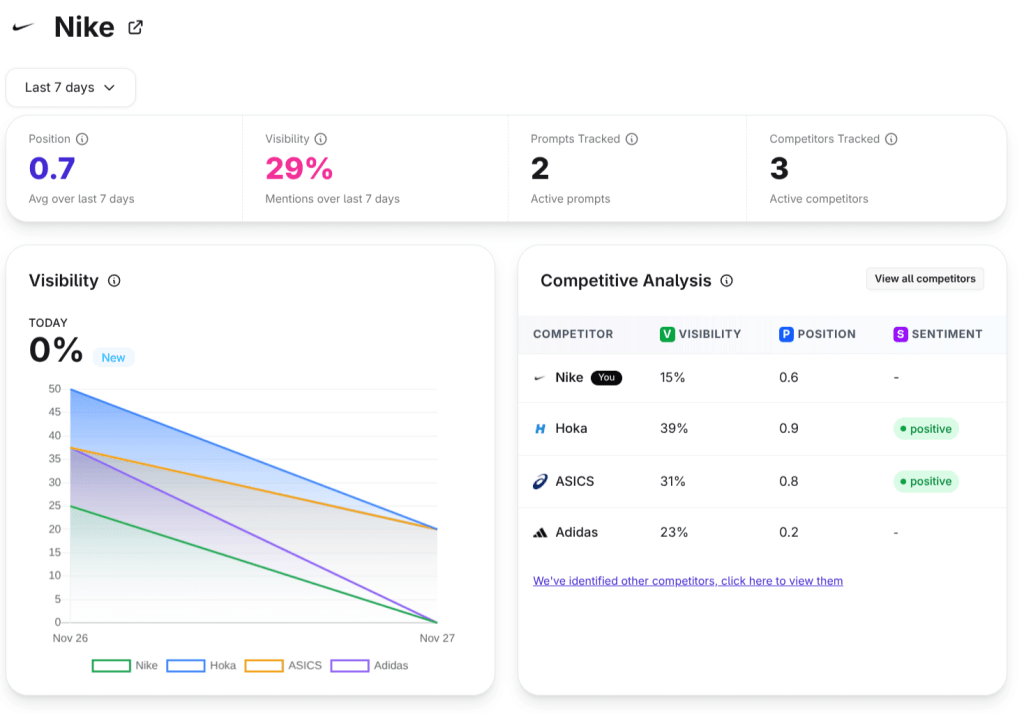
    Cartesiano.ai Dashboard

    Hey everyone! Today’s a big day for us. After months of obsessing over the future of search and how people discover products online, we’re thrilled to introduce Cartesiano.ai, our new AI Search Intelligence platform.

    If you’ve been paying attention to how people look for recommendations lately, you’ve probably noticed the shift: instead of digging through endless Google results, more and more people are simply asking AI assistants what they should buy or use. Tools like ChatGPT, Google’s Gemini, and others are becoming the starting point for product research, and their answers seriously influence buying decisions.

    That’s a massive change. And it opens up an entirely new channel for companies to grow… as long as you can understand how your brand actually shows up in these AI-generated answers.

    That’s exactly why we built this.

    Helping you understand what AI says about your brand

    Here’s the simple idea behind our platform: if customers are asking AI assistants for advice, your brand should be part of the conversation, and you should know how you’re being represented.

    Let’s say you sell HR software. When someone asks, “What’s the best HR tool for small businesses?” the model’s response matters. Are you mentioned? Are you recommended? Are you buried? Are you described accurately? We help you get clarity on all of that.

    We work with you to capture the real prompts your customers are actually asking. Then, every single day, we run those prompts across major AI models and evaluate:

    • Visibility: how often your brand appears in answers
    • Position: where you show up when listed with competitors
    • Sentiment: whether you’re described in a positive or negative way
    • Trends: what’s changing over time
    • Sources: which articles, reviews, or sites the AI relies on to form its answers


    ❤️ We’re genuinely proud of this product, not just because it works, but because we know how important this new search landscape is for modern companies. This is a chance to understand a whole new customer journey, and we’re excited to help you make the most of it.

    We’ve put everything you need, from documentation, guides, best practices, insights, right inside the product.

    What does the future hold?

    We’re currently in beta mode and since then we’re talking to early users who are helping us shape and improve the product. We launched generous plans which includes powerful features to help any company start tracking their AI presence.

    We encourage any type of feedback, so feel free to contact us at hello@cartesiano.ai